Tracking, Detection and Registration in Microscopy Material Images
- 61 views
Monday, June 25, 2018 - 08:30 am
Meeting room 2267, Innovation Center
DISSERTATION DEFENSE
Author : Hongkai Yu
Advisor : Dr. Song Wang
Abstract
Fast and accurate characterization of fiber micro-structures plays a central role for material scientists to analyze physical properties of continuous fiber reinforced composite materials. In materials science, this is usually achieved by continuously cross-sectioning a 3D material sample for a sequence of 2D microscopic images, followed by a fiber detection/tracking algorithm through the obtained image sequence.
To speed up this process and be able to handle larger-size material samples, we propose sparse sampling with larger inter-slice distance in cross sectioning and develop a new algorithm that can robustly track large-scale fibers from such a sparsely sampled image sequence. In particular, the problem is formulated as multi-target tracking and Kalman filters are applied to track each fiber along the image sequence. One main challenge in this tracking process is to correctly associate each fiber to its observation given that 1) fiber observations are of large scale, crowded and show very similar appearances in a 2D slice, and 2) there may be a large gap between the predicted location of a fiber and its observation in the sparse sampling. To address this challenge, a novel group-wise association algorithm is developed by leveraging the fact that fibers are implanted in bundles and the fibers in the same bundle are highly correlated through the image sequence.
Tracking-by-detection algorithms rely heavily on detection accuracy, especially the recall performance. The state-of-the-art fiber detection algorithms perform well under ideal conditions, but are not accurate where there are local degradations of image quality, due to contaminants on the material surface and/or defocus blur. Convolutional Neural Networks (CNN) could be used for this problem, but would require a large number of manual annotated fibers, which are not available. We propose an unsupervised learning method to accurately detect fibers on the large scale, which is robust against local degradations of image quality. The proposed method does not require manual annotations, but uses fiber shape/size priors and spatio-temporal consistency in tracking to simulate the supervision in the training of the CNN.
Due to the significant microscope movement during the data acquisition, the sampled microscopy images might be not well aligned, which increases the difficulties for further large-scale fiber tracking. We design an object tracking system which could accurately track large-scale fibers and simultaneously perform satisfactory image registration. Large-scale fiber tracking task is accomplished by Kalman filters based tracking algorithms. With the assistance of fiber tracking, the registration error is minimized via a physics optimization model embedded with fibers' 3D trajectory constraints.
To evaluate the proposed methods, a dataset was collected by Air Force Research Laboratories (AFRL). The material scientists in AFRL used a serial sectioning instrument to cross-section the 3D material samples. During sample preparation, the samples are ground, cleaned, and then imaged. Experimental results on this collected dataset have demonstrated that the proposed frameworks yield significant improvements in large-scale fiber tracking and detection, together with improved image registration.
Date : June 25th , 2018
Time : 8:30 am
Place : Meeting room 2267, Innovation Center
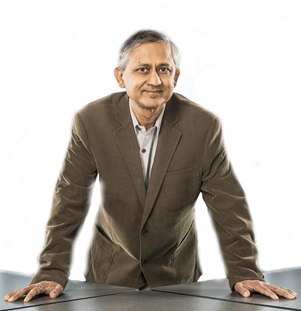 Prof. Amit P. Sheth
Abstract: While Bill Gates, Stephen Hawking, Elon Musk, Peter Thiel, and others engage in OpenAI discussions of whether or not AI, robots, and machines will replace humans, proponents of human-centric computing continue to extend work in which humans and machines partner in contextualized and personalized processing of multimodal data to derive actionable information.
This talk describes how maturing towards the emerging paradigms of semantic computing (SC), cognitive computing (CC), and perceptual computing (PC) provides a continuum through which to exploit the ever-increasing and growing diversity of data that could enhance people’s daily lives. SC and CC sift through raw data to personalize it according to context and individual users, creating abstractions that move the data closer to what humans can readily understand and apply in decision-making. PC, which interacts with the surrounding environment to collect data that is relevant and useful in understanding the outside world, is characterized by interpretative and exploratory activities that are supported by the use of prior/background knowledge. Using the examples of personalized digital health and a smart city, we will demonstrate how the trio of these computing paradigms form complementary capabilities that will enable the development of the next generation of intelligent systems. For background:
Prof. Amit P. Sheth
Abstract: While Bill Gates, Stephen Hawking, Elon Musk, Peter Thiel, and others engage in OpenAI discussions of whether or not AI, robots, and machines will replace humans, proponents of human-centric computing continue to extend work in which humans and machines partner in contextualized and personalized processing of multimodal data to derive actionable information.
This talk describes how maturing towards the emerging paradigms of semantic computing (SC), cognitive computing (CC), and perceptual computing (PC) provides a continuum through which to exploit the ever-increasing and growing diversity of data that could enhance people’s daily lives. SC and CC sift through raw data to personalize it according to context and individual users, creating abstractions that move the data closer to what humans can readily understand and apply in decision-making. PC, which interacts with the surrounding environment to collect data that is relevant and useful in understanding the outside world, is characterized by interpretative and exploratory activities that are supported by the use of prior/background knowledge. Using the examples of personalized digital health and a smart city, we will demonstrate how the trio of these computing paradigms form complementary capabilities that will enable the development of the next generation of intelligent systems. For background: 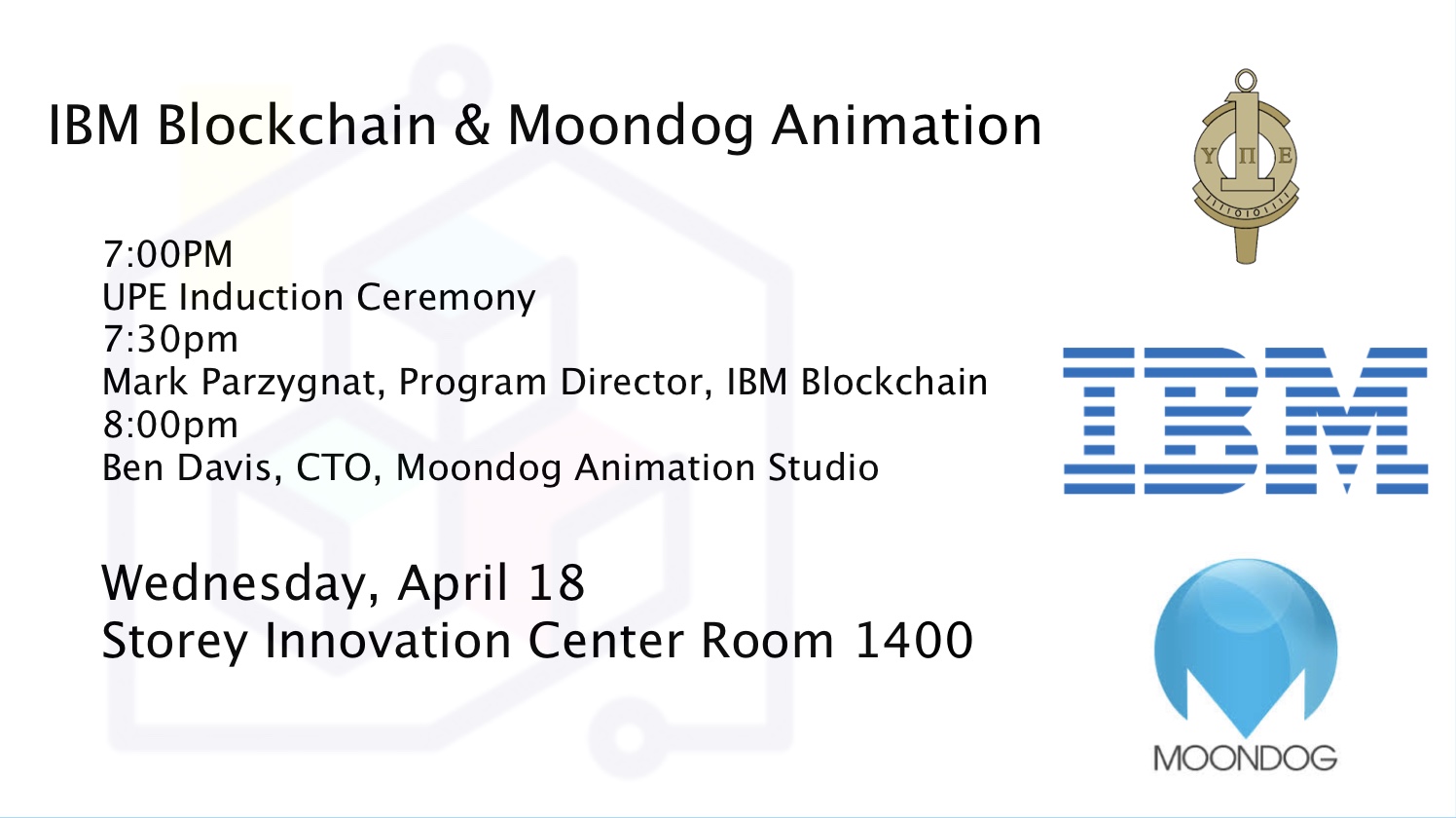 The Center for Advanced Analytics and Applied Innovation is hosting speakers Mark Parzyngat, Program Director at IBM Blockchain, and Ben Davis, Chief Technology Officer at Moondog Animation Studio. Tech talks will follow the induction ceremony of Upsilon Pi Epsilon, the Computing honor society.
Jim Stritzinger, Director of the Center for Advanced Analytics and Applied Innovation, is organizing this event.
The Center for Advanced Analytics and Applied Innovation is hosting speakers Mark Parzyngat, Program Director at IBM Blockchain, and Ben Davis, Chief Technology Officer at Moondog Animation Studio. Tech talks will follow the induction ceremony of Upsilon Pi Epsilon, the Computing honor society.
Jim Stritzinger, Director of the Center for Advanced Analytics and Applied Innovation, is organizing this event. Over the past few months, 18 mobile app ideas have been developed in conjunction with the computer science department. We are hosting a showcase competition for the 18 teams.
Why Attend?
Over the past few months, 18 mobile app ideas have been developed in conjunction with the computer science department. We are hosting a showcase competition for the 18 teams.
Why Attend?